



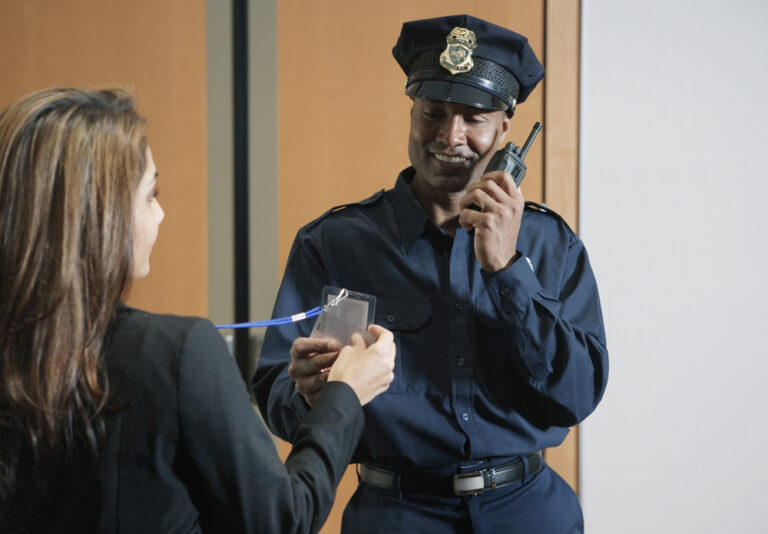


Court Services Officers spend most of their time in the courtroom. These officers help ensure hearings unfold in a calm and orderly fashion. They make sure proceedings in the courtroom are conducted securely and without any hitches.
Learn more about the different aspects of a Court Services Officer’s work!
- Courtrooms, courthouses, courts of appeal
- High school diploma (minimum)
- Bilingualism required for some positions
-
The work of a court services officer
Duties
Court Services Officers play an important role in keeping proceedings and hearings running smoothly. In Alberta, they are called “clerks” or “clerk officers”.
Sometimes the duties of a Court Services Officer are carried out by other individuals, such as security officers or police officers or even the court clerk. In New Brunswick, for example, the duties of the Court Services Officer are carried out by the Sheriff in addition to his or her other responsibilities. All these individuals contribute to making sure everything runs as it should before, during and after a hearing.
Regardless of the duties Court Services Officers carry out, they are always conscious of their main responsibility, which is to assist the judge presiding over the hearing.
Before the hearing
Preparing the necessary materials
The Court Services Officer gets the courtroom ready for the hearing to begin. For example, the officer:
- Ensures the judge, lawyers and the parties have everything they need (paper, pencils, water, etc.);
- Ensures the judge has copies of relevant statutes; and
- Helps the court clerk bring the many files to the courtroom.
Providing assistance during the hearings
When everything is ready and it’s time for the hearing to begin, the Court Services Officer:
- Checks the lawyers and the parties are present and asks them to enter the courtroom if they are not yet inside;
- Asks anyone other than the lawyers and the parties to leave the courtroom for closed hearings (the public and the media cannot be present);
- Escorts the judge from his or her office to the courtroom and ensures the judge’s safety; and
- Acts as a messenger between the judge and lawyers if the hearing is delayed for some reason.
During the hearing
When the judge arrives, the Court Services Officer opens the hearing by asking everyone to remain quiet and then rise by saying, “Order; All rise” for example. The judge then takes his or her seat.
During the proceedings, the Court Services Officer:
- Ensures the safety of the judge;
- Remains still for long periods of time listening to testimonies and pleadings;
- Makes sure the proceedings unfold calmly and quietly;
- Ensures safety in the courtroom;
- Remains attentive to situations where his or her services are required (for example, to photocopy documents or meet with witnesses waiting outside the courtroom);
- Sees that journalists follow the relevant rules of the court and the courthouse that apply;
- May be required to get signatures required on various documents;
- Maintains court decorum, ensuring proper protocol is followed in the court (may have to ask people to remove their hat or sit correctly, for example);
- Calls witnesses and provides them with assistance if necessary;
- Assists the jury; and
- Carries out any duties the judge may ask of him or her.
In short, the Court Services Officer makes life easier for the judge, lawyers, witnesses and parties by discreetly looking after all of these details.
-
Workplace
There are Court Services Officers in all courts of justice, including the appeals courts of all provinces and territories, as well as in the Supreme Court of Canada.
-
Education and training
There is no specific program for becoming a Court Services Officer. You must have a secondary school diploma (outside Quebec) or a DEC (in Quebec). For some positions, bilingualism or a valid driver’s license may also necessary.
To acquire the knowledge and develop the skills needed for this position, candidates follow the training offered by their employer. Training or experience in the legal field, and particularly in a safety – or security-related field, is a definite asset.
-
Challenges
Court Services Officers face a number of challenges. In cases receiving a lot of media attention, the role of the Court Services Officer is particularly important, and will continue to be so in order to ensure the safety of the parties involved and to protect their privacy.
For example, cameras (other than cameras allowed by the courts in specific situations) are prohibited in the courtroom. However, the advent of cellular phones with video cameras and other technological tools have made enforcing this rule more difficult.
Safety in courts of law in general is an issue future Court Services Officers should be concerned with. Any training or specialization a candidate may have in this area would be an asset.
-
Necessary skills
Do you have what it takes to become a Court Services Officer?
Consult this list of key competencies and learn how to develop the skills that would be helpful to you as a Court Services Officer.
Knowing the rules of the courtroom
Court Services Officers must be very familiar with the rules of decorum, proper protocol and other rules that apply inside a courtroom in order to ensure everyone follows them.
You have what it takes if:
- You usually arrive on time for all your appointments and classes;
- You follow the rules when you play a game and never cheat; and
- You are disciplined when it comes to studying and don’t waste your time.
Ability to listen
Courts services officers must be good listeners and show discretion because they are present at hearings, including closed hearings (hearings closed to the public), where a great deal of personal information is disclosed.
You have what it takes if:
- You can listen attentively to others;
- You listen more than you talk during conversations with friends; and
- You can easily retain the details of stories you hear.
Firmness
Court Services Officers must sometimes ask people who are not obeying the rules of decorum to leave, which requires officers to be confident and firm.
You have what it takes if:
- You can defend a controversial position during a discussion;
- You can express your dissatisfaction when the circumstances warrant it; and
- You can exercise discipline when you are in a position of authority or are acting as team leader.
Ability to control your emotions
Because Court Services Officers may find themselves in crisis situations, they must be able to handle pressure well and keep their cool in tense situations.
You have what it takes if:
- You do not react aggressively when provoked;
- You are able to maintain your concentration in stressful situations, such as when you are studying the night before an exam;
- You are able to help resolve conflicts without getting emotional;
- You are comfortable talking to people of different backgrounds, cultures and age groups; and
- You know how to create order and command respect when working as part of a team.
Diplomacy
Court Services Officers must be polite with everyone they meet, whether judges, lawyers or the parties involved in a case. Like others involved in the legal system, Court Services Officers represent the justice system and must be courteous at all times.
You have what it takes if:
- You know how to give constructive criticism to others without hurting their feelings;
- You are not the type to spread rumors and can keep sensitive information confidential; and
- You are known as someone who is polite to everyone.
These are just some examples of the skills you will need, along with qualities like having good judgment and being observant, to be a good Court Services Officer.