



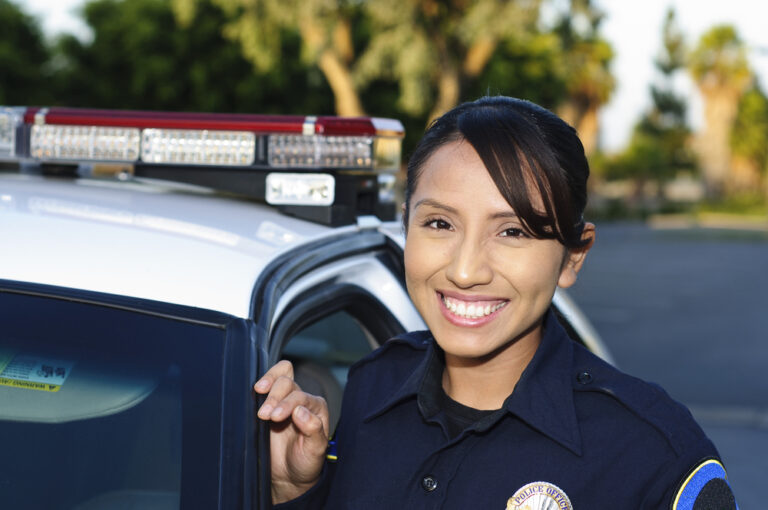


Police officers play an important role in maintaining order and ensuring public safety. Their work is not limited to emergency situations like accidents or arrests, for example, or to ongoing criminal investigations. A big part of a police officer’s work involves working with the public to provide information as well as crime prevention.
Learn more about the different aspects a police officer’s work!
- Patrol, investigation, emergency response, community policing
- High school diploma (minimum)
- Police training provided when hired
-
The work of a police officer
Duties
A police officer’s work involves four main types of activities: crime prevention, emergency response, investigations and coordinating police services.
Crime prevention
The main aspect of a police officer’s work, and certainly the one normally associated with the early stage of an officer’s career, is crime prevention. This involves:
- Maintaining order;
- Ensuring public safety; and
- Enforcing laws and regulations.
Programs
Keeping the peace and ensuring public safety wouldn’t be possible without the cooperation of citizens. As a result, police officers work very closely with members of the community to prevent crimes. A police officer’s crime prevention duties include:
- Organizing information sessions about safety and crime prevention (aimed at youth, seniors or representatives of the business community, for example);
- Participating in community programs, such as Block Parents, which encourages parents to make their neighbourhood safer for children, and Neighbourhood Watch, a program aimed at preventing crime at the local level;
- Developing partnerships with local community organizations and institutions.
Patrolling
Prevention is a big part of police officers’ work. In fact, simply having a police officer patrol an area discourages people from committing crimes and other violations. Day and night, officers contribute to preventing crimes by:
- Patrolling areas (on bikes, by car or on foot);
- Keeping watch over homes, businesses and public places looking out for suspicious activity;
- Enforcing speed limits;
- Ensuring people are protected; and
- Being present during protests and special events to make sure crowds stay under control.
Emergency response
Whether it’s a crime, an accident, a natural disaster or any other kind of emergency, police officers are called to:
- Respond to emergency calls;
- Help victims;
- Arrest suspects;
- Give first aid; and
- Direct traffic.
Specialized operations
Specialized officers must deal with dangerous situations that require specialized skills. These officers manage hostage situations and rescue operations, try to prevent suicides and intervene when a person is threatening another individual.
Depending on their specialization, officers may also:
- Handle explosives;
- Defuse bombs;
- Subdue or disarm individuals with weapons;
- Manage hostage situations; or
- Scuba dive to conduct recovery operations.
Investigations
Police conduct investigations for a variety of reasons:
- Commercial scams;
- Terrorist planning activities;
- Arms trafficking;
- Kidnapping;
- Murder; and
- Vehicle theft.
The results of police investigation are always shared with the crown attorney offices because they lay any criminal charges against suspects.
Judicial process
The police are involved in the judicial process by:
- investigating criminal acts and accidents;
- gathering proofs and interviewing witnesses;
- writing police reports; and
- appearing at court hearings.
Surveillance
A police officer may be involved in undercover operations in a prison or as a member of a gang in order to gather evidence. Officers conducting physical surveillance use a variety of techniques and approaches in order prevent being detected. They may:
- Monitor the activities of an individual and the people they associate with;
- Take photos; and
- Keep a written record of what they observe.
Coordinating police services
A number of veteran officers are involved in organizing police services. They may:
- Help develop crime prevention programs;
- Plan public information sessions on safety; and
- Oversee and coordinate the activities of other police officers.
-
Workplace
Police officers may work in a variety of environments and have varying shifts depending on whether they are carrying out an investigation, patrolling, working in the community or dealing with emergencies. Officers may work indoors, outdoors, in offices or in vehicles.
Depending on the officers’ skills and specialty, they may:
- Monitor parks or give talk in schools;
- Scuba dive to recover bodies;
- Conduct investigations in forests;
- Carry out searches using police dogs (known as K-9 units),
- Manage crowds during demonstrations; and
- Conduct electronic surveillance using computer equipment.
Shift work
Public safety is of the utmost importance at all times. This means there are police officers on the job 24 hours a day. Anyone who chooses a career as a police officer should be prepared to work evenings, nights as well as weekends.
Police forces
Depending where you live in Canada, you have federal, provincial, regional or municipal police forces. The Canadian Armed Forces also has a police force. To learn more about the main police forces in Canada, and particularly those in Ontario, visit any of the following websites:
For information on police forces in other provinces and territories, simply click on the province you are interested in. Alberta, British Columbia, Manitoba and New Brunswick do not have a provincial police force. They do have, however, municipal police forces. Everywhere in Canada except Ontario and Quebec, the RCMP serves as the provincial police force.
Click on the links below to visit the websites of some of the police forces in these provinces.
Alberta
British Columbia
Manitoba
Nova Scotia
Quebec
-
Education and training
To become a police officer, you must have a secondary school diploma (outside Québec) or a CÉGEP diploma, or DEC (in Québec). Postsecondary studies, while not required, are an asset.
In Ontario, you can do your training in French in the Techniques de services policiers program at La Cité or at some campus of Collège Boréal.
In any case, if you are hired on by any police service, you will receive training before you begin active duty. If you accept an offer of employment from the Ontario Provincial Police or the Ottawa Police Services, for example, you will do your training at the Ontario Police College.
Each police force has its own hiring policies and requirements. For exemple, here are the requirements for the Ontario Provincial Police and the Royal Canadian Mounted Police:
Ontario Provincial Police (OPP)
1. Canadian citizen or permanent resident
2. Minimum 18 years of age
3. Ontario grade 12 or equivalent
4. Valid class “G” driver’s licence (with proof of a good driving record)
5. No criminal record
6. Certified in first aid and CPR (level “C”)
7. Proof of credits obtained during your studies
8. Proof of test results (a certificate testifying you have passed the entrance tests, such as the medical exams)
9. Willing to serve anywhere in the province
To find out more, visit the “Careers” section of the OPP website.
Royal Canadian Mounted Police (RCMP)
1. Canadian citizen
2. Of good character (no police record)
3. Be proficient in English or French
4. Canadian secondary school (high school) diploma or equivalent
5. Valid class “G” driver’s licence
6. At least 19 years of age at the time of hiring
7. Meet medical and health standards
8. Willing to relocate anywhere in Canada
9. Physically fit
If you are hired by the RCMP, you must complete a 24-week training program in Regina, Saskatchewan. To find out more, visit the “Careers” section of the RCMP website.
-
Challenges
In our growing multicultural society, one of the main challenges police forces are facing is to better reflect the diversity of the people in the communities they serve. Forces make efforts to recruit people of all backgrounds and cultures.
Police forces must continually improve their ability to provide efficient services that respond to the needs of their communities. Members of the police force keep up-to-date by regularly attending refresher courses and professional development activities.
We live in an age driven by new technology. As a result, candidates with training in this area are in high demand.
To find out more about employment prospects for police officers, visit the websites of the police forces you are interested in.
-
Necessary skills
Consult this list of important skills necessary for a career as a police officer.
Ability to interact well with others
Police officers must be able to build and maintain solid relationships with people both inside and outside the police force. They must also be able to work in a team and cooperate with others.
You have what it takes if:
- You do not react aggressively when provoked;
- You are able to maintain your concentration in stressful situations, such as when you are studying the night before an exam; and
- You are able to help resolve conflicts without getting emotional.
Ability to be firm
Police officers must be self-confident and exercise authority in difficult situations.
You have what it takes if:
- You can defend a very controversial position during a discussion;
- You are clear with your feelings when you are not happy with certain situations;
- You know how to keep control of a situation and be firm (for example, when you are babysitting).
Ability to control your emotions
Because police officers regularly deal with crisis situations, they must be able to handle pressure and maintain their cool, even in tense situations.
You have what it takes if:
- You do not react aggressively when provoked;
- You are able to maintain your concentration in stressful situations, such as when you are studying the night before an exam; and
- You are able to resolve conflicts without getting emotional.
Ability to remain neutral
Like everyone, police officers have family, friends and acquaintances. Despite this, police officers must remain neutral with everyone and apply the law equally, even when it is difficult to do so.
You have what it takes if:
- You remain objective if you have a disagreement, even if it involves a friend;
- You are able to resolve conflicts without letting your emotions get in the way; and
- You are able to find compromises to situations involving your parents or teachers.
These are just some examples of skills you would need. Other qualities, like good judgment and being courageous, would certainly help make you an excellent police officer.